

Read
4 minute read
December 19, 2025
4 minute read
On December 5, 2025, the EPA's Office of Enforcement and Compliance Assurance (OECA) issued a memorandum adopting a "compliance first" approach to environmental enforcement.[1] The memorandum, signed by OECA’s Acting Chief Craig Pritzlaff, (referred to as the “Pritzlaff memo”) represents a significant policy shift for EPA civil and administrative enforcement efforts that prioritizes prompt compliance over traditional enforcement mechanisms. The Pritzlaff memo coincides with a dramatic reduction in the number of judicial enforcement actions taken by EPA and aligns agency policy with the current administration's broader economic and energy policy objectives.
Two key aspects of this policy shift announced through the Pritzlaff memo are (1) heightened standards for issuing violations; and, (2) limitations on the scope of injunctive relief.
Heightened Standards for Issuing Violations
The Pritzlaff memo directs OECA personnel to prioritize compliance through "the most efficient, most economical, and swiftest means possible,"[2] with a stated priority to quickly bring sources into compliance through informal enforcement actions and “find-and-fix” compliance assurance initiatives rather than protracted formal enforcement actions. The memo establishes strict requirements for findings of violation, instructing that violations must be "clear and unambiguous, well-tailored, and based on the best reading of the relevant statute and regulation."[3] Further, the memo seeks national uniformity in enforcement decisions, instructing that enforcement of ambiguous provisions "must be made at a national level to ensure national consistency of federal law."[4] For the regulated community, this means where there are any material ambiguities in EPA’s application of statutory or regulatory requirements, "such questions must be elevated immediately for further analysis" to EPA headquarters.[5]
Limitations on Injunctive Relief
The Pritzlaff memo also announced significant restrictions on the scope of injunctive relief EPA may seek in settlements, providing: (1) injunctive relief must be "well-tailored to address specific violations" and "reflect a clear nexus to the governing statute and implementing regulations"; (2) relief "outside clear regulatory or statutory requirements may be appropriate in limited, case-specific circumstances" but requires "approval from OECA Assistant Administrator"; (3) "imposing monitoring and reporting requirements that exceed regulatory parameters is generally not appropriate"; and (4) third-party audits or monitoring must be cleared by the OECA Assistant Administrator.[6] In addition, the Pritzlaff memo rescinds a Biden-era policy on injunctive relief,[7] and directs that supplemental environmental projects (SEP) shall not be included in any settlement agreements until EPA issues additional guidance.
Additional Policy Considerations
In addition to the announced changes in findings of violations and injunctive relief, the Pritzlaff memo describes four other factors as the foundation for this “compliance first” operating framework:
- Deployment of compliance assistance tools to provide technical assistance and training to regulated entities and to promote voluntary compliance;
- Coordination with state partners to ensure consistency in compliance determinations and that OECA enforcement actions are based on a clear federal interest;
- Open communication and collaboration with state, local, and tribal agencies and the regulated community; and,
- Reasoned decision-making on all determinations of noncompliance and means for achieving compliance.
Decline in Judicial Enforcement Activity
The compliance-first policy correlates with a reduction in federal judicial enforcement of EPA administered laws and regulations. According to EPA’s enforcement data, there has been a reduction in the number of civil actions brought by the U.S. Department of Justice (USDOJ) on behalf of EPA in the first nine months of this administration, as shown in the chart below.
Figure 1: USDOJ Enforcement Actions for EPA: From Inauguration to Thanksgiving in First-Term Administrations[8]
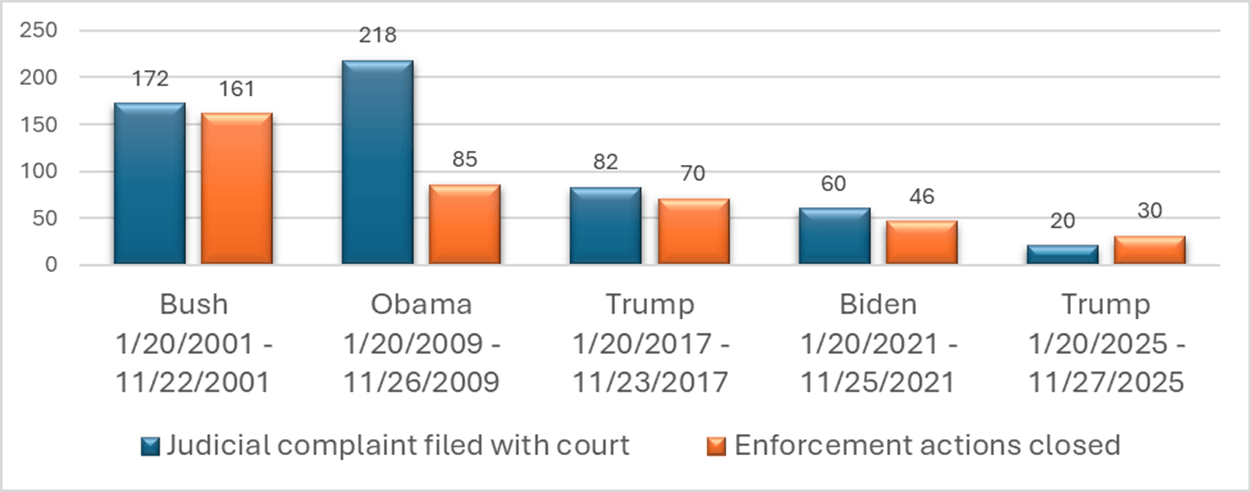
This enforcement data reveals that the current administration's approach represents not merely a return to policies under the first Trump administration, but a further reduction in enforcement activity. The 20 judicial complaints filed through late November 2025 represent the lowest level of federal environmental enforcement activity in the modern era, falling below all recent administrations regardless of party.
Implications for Regulated Entities
In light of the Pritzlaff memo and considering the drop in judicial enforcement actions, regulated entities may face lower financial penalties, more narrowly tailored compliance requirements, and reduced likelihood of third-party monitoring obligations. The Pritzlaff memo emphasizing the "best reading" of statutes and regulations further suggests that EPA may avoid aggressive or novel legal theories. For parties currently in enforcement proceedings with EPA and/or USDOJ concerning environmental regulation the Pritzlaff memo introduces an opportunity to raise concerns about any statutory and regulatory ambiguity and to request a clear connection between injunctive relief sought and the underlying statutes and regulations on which the action is based.
The combination of procedural safeguards, centralized approval requirements and limitations on injunctive relief suggest enforcement activity will remain at historically low levels. However, companies should recognize that enforcement philosophies can shift dramatically with changes in administration. Maintaining robust compliance programs and addressing violations promptly to return to compliance remain the most prudent long-term strategy, regardless of the shifting winds of enforcement climate.
The Pritzlaff memo reinforces longstanding strategic considerations for the regulated community: proactive compliance, voluntary disclosure of potential violations, and early engagement with state and federal regulators. EPA’s longstanding “Audit Policy” rewards such behavior,[9] and is complimented by the current administration’s “compliance first” policy.
Our Regulatory Team at Michael Best is here to help advise you and your business on the impact of this policy on your project or facility. If you have questions about how this policy may affect your business, please contact your Michael Best attorney or a member of our team listed on this alert.
[1] EPA Memorandum from Craig J. Pritzlaff regarding “Reinforcing a ‘Compliance First’ Orientation or Compliance Assurance and Civil Enforcement Activities” (December 5, 2025).
[2] Id.
[3] Id. at 4.
[4] Id.
[5] Id.
[6] Id. at 5.
[7] Id. rescinding EPA memorandum, “Using All Appropriate Injunctive Relief Tools in Civil Enforcement Settlements” (April 26, 2021).
[8] Based on EPA’s Enforcement and Compliance History Online (ECHO) database, https://echo.epa.gov/.
[9] See “Incentives for Self-Policing: Discovery, Disclosure, Correction and Prevention of Violations,” 65 Fed. Reg. 19618 (April 11, 2000); “EPA’s Audit Policy,” https://www.epa.gov/compliance/epas-audit-policy.
Related People

Matthew McNerney
Senior Associate
Matt.McNerney@michaelbest.com
T 720.398.0055
*Not admitted in Colorado

Todd E. Palmer
Partner
Sub-Group Leader, Environmental & Natural Resources
tepalmer@michaelbest.com
T 608.283.4432

David A. Crass
Partner
Industry Group Co-Chair, Agribusiness, Food & Beverage
dacrass@michaelbest.com
T 202.595.7921

Leah Hurtgen Ziemba
Partner
Practice Group Chair, Regulatory
Industry Group Co-Chair, Agribusiness, Food & Beverage
lhziemba@michaelbest.com
T 608.283.4420