
Read
2 minute read
October 7, 2026
2 minute read
Over the past eighteen months, Patent Trial and Appeal Board (PTAB) practice has undergone one of its most significant transformations since the America Invents Act created inter partes review (IPR) and post-grant review (PGR). The result has been a sudden increase in petition denials and a substantial decrease in new PTAB petitions being filed.
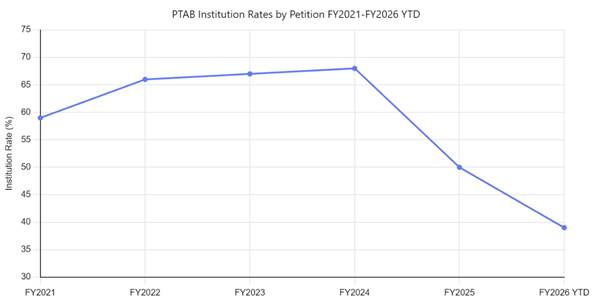
The numbers are striking. While institution rates for PTAB petitions have held steady in the 59%-68% range for fiscal years 2021-2024, the institution rate for FY 2025 dropped to 50% and the current FY2026 data shows an institution rate of only 39%.
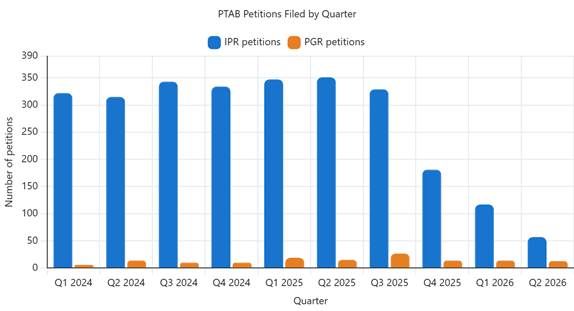
Petitioners reacted by filing fewer PTAB petitions. The chart below shows that from Q1 2024 through Q3 2025 quarterly filings of PTAB petitions held steady in the 300-350 range. Starting in Q3 2025, the quarterly number of PTAB petitions plummeted from 181 to 117 to only 57 in Q2 2026. According to the recently published LexMachina_2026_Patent_Litigation_Report Aug 2026[KM1], the first half of 2026 produced fewer PTAB petitions than any comparable six-month period in at least a decade.
Many observers attribute this decline in petition filings to the USPTO's expanded use of discretionary denials. In March 2025, the Office implemented an interim workload-management process under which discretionary considerations were separated from the merits analysis and evaluated first. The process placed significant authority in the hands of the USPTO Director, who became the central decision maker for many institution determinations. The change coincided with increased scrutiny of petitions involving parallel district court litigation and other policy-based considerations. According to the Lex Machina report, many accused infringers responded by reserving PTAB challenges for only their strongest cases while relying more heavily on district court invalidity defenses, licensing strategies, settlements, and ex parte reexaminations.
Against this backdrop, a potentially significant development emerged in September 2026. Reports indicate that USPTO Director John Squires intends to relinquish direct control over institution decisions and return primary authority to PTAB panels, reversing the October 2025 move that centralized institution authority within the Director's office. If implemented, the change would represent a meaningful departure from the highly centralized decision-making model that has characterized PTAB practice over the past year.
Whether the shift will materially alter institution rates remains uncertain. PTAB panels will continue applying the same statutes, regulations, and precedential decisions governing IPRs and PGRs. Nonetheless, returning institution decisions to three-judge PTAB panels may shift focus back toward substantive issues and less on discretionary denials. If that occurs, we can expect the number of PTAB petitions to start ticking upward.